Sunday, April 10, 2011

Encountering "the real" in the films of Roberto Rossellini

I don't know about you, but reading dense academic articles about foreign films is my idea of a good time. In the article “Encounters in the real: subjectivity and its excess in Roberto Rossellini,” film and psychoanalytical expert Fabio Vighi takes a look at the films of famous Italian director Roberto Rossellini. We've watched two Rossellini films so far (Rome, Open City and Germany, Year Zero), and the article mentions both of them. Vighi takes a psychoanalytical approach to viewing the films, drawing heavily on the work of 20th century psychoanalyst Jacques Lacan.

I have to admit that this article was incredibly hard to understand. The author wrote in an impenetrable academic style that made my eyes gloss over on more than one occasion. From what I gather, Vighi's main premise was that Rossellini's films, especially Rome, Open City and Paisàare best viewed through a psychoanalytic lens. The main characters in the films “encounter the real” in tragic ways that allow them to overcome their subjective limitations and die heroically...or something like that.

The article dealt a lot with the term jouissance, which comes from the magical realm of Lacanian psychoanalysis. Since it was used about a hundred times, I decided I should look up what the term meant so I could feel slightly better about myself. Turns out the term is synonymous with pleasure or enjoyment. The author of the article was basically arguing that the characters came to terms with their desire in each of Rossellini's films. The author also pointed out the sexual tension that existed between male and female characters and how Rossellini depicts the impossibility of communication between the sexes. I found this section of the article to be the easiest to understand, primarily because it dealt with some ideas I've already been exposed.

Overall, this article provided a lot of insight into the sheer depth and complexity of film criticism. It also made me feel incredibly dumb. It's amazing to know that academics who seriously study film have intense conversations full of polysyllabic words about aspects of films that I never even think about. So next time you watch one of Rossellini's films, apparently you should have a psychology textbook and a graduate degree in psychoanalytic theory with you, just to be on the safe side.

Saturday, April 9, 2011

Germany Year Zero

Germany Year Zero was filmed in 1948 as the final chapter to director Roberto Rossellini’s War Trilogy.  According to the criterion collection, Rossellini was one of the most influential film makers of all time and his works came to define the neorealist movement.  The review suggest that by being“shot in battle-ravaged Italy and Germany, these three films are some of our most lasting, humane documents of devastated postwar Europe, containing universal images of both tragedy and hope.”

This film is titled “Year Zero” to correlate with “Anno Zero” which identifies the time when new currency was introduced, and the economy started again from scratch. Each German family was given the same small amount of money to rebuild their lives and their country. Glimpses of the black market, prostitution and the destroyed city are portrayed in scene after scene. The desperation of the people is displayed as the people jokes about jumping in the graves they’re digging and scavenge after the meat of a fallen horse.

Specifically, the film frames the young character Edmund in the disheartening story set in the actual post World War II Berlin. Between the sister who is caring for their ill father and his ex-Nazi brother in hiding, Edmund is forced to be the man of the house in order to help his family survive. He drops out of school in hopes of finding work, only to be denied this desire because of his young age. When this plan falls through, Edmund rummages the city in search of any means of employment or food. 

It is after running into a previous teacher, that Edmund finds himself taking desperate measures in order to support his family. At age twelve, he is too naive to understand the remaining presence of the Nazi regime and the danger of their thinking. With each attempt, he fails and finds himself in a bigger dilemma than before. This is emphasized when he misunderstands his teacher’s Nazi speech about the survival of the stronger and makes the bold decision to poison his father’s food so that he will no longer be a burden to his starving family. When his teacher denies ever giving Edmund the suggestion of murder, he enters a state of overwhelming guilt. As he moves to the top of an abandoned building, he sees no other choice than to end his own life.

One review suggests that Germany Year Zero “hammers the audience with an unpalatable truth: the ones who suffered most as a result of the scourge of Nazism are the German people themselves."This is clearly evident in the lives of the families and the state of desperation that shadows the nation.

Wednesday, April 6, 2011

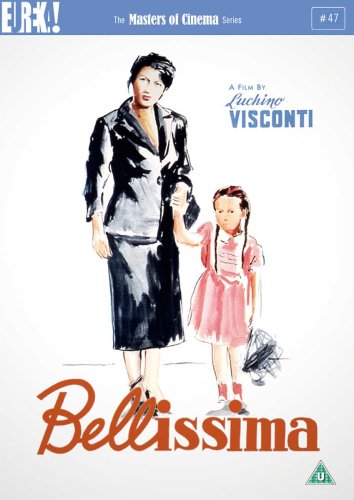
Bellissima

Bellissima is a black-and-white Italian Neo-Realism film that was made 1951. The opening scene portrays hundreds of girls, ages six to eight, rushing to be the first in line at the tryouts. One girl will be chosen from the tryouts to be in the next film. Meanwhile one mother is desperately looking for her daughter Maria. Finally the mother finds Maria by the pool, and yells at her for disappearing. The mother believes it is too late for Maria to tryout, until one of the directors tells her that the auditions are not over. The mother demands that Maria tries out for the part.

Meanwhile the father is worried about them because they are never home after dark. Upon arriving home the mother says that they went to the city, but the father does not believe her. Eventually she ends up telling the truth. The father is not pleased, but he knows that he cannot change his wife’s wishes. Next, the film shows how the mother is always working, so that she can pay for the expanses. Also, the mother makes Maria take acting lessons from a retired actress. Maria wants nothing to do with anything concerning film. Next, the mother demands that Maria gets her picture taken, but Maria cries instead of smiles. Eventually the father asks Maria what is wrong, and she tells him that she does not want to be in film. Since, the mother is not very successful, she wants Maria to be famous to make up for it. Everything the mother does is to get Maria into film. Maria still does not want any part of it.

After several acting and dance lessons, the mother believes that Maria is ready to go to the screen test. The screen test displays how individuals will act while being taped. At first, Maria is fine with the screen test. Then she sees the camera and starts to cry. Meanwhile the mother is watching the screen test, and becomes upset that everyone is laughing at her daughter. The mother is heartbroken, and realizes that all her dreams are destroyed. Maria and her mother go to a park, but lose track of time. Finally, they return home, only to find the film contractors in the kitchen. The film director states how he needs a girl that can show emotion, and Maria is the best one for the part. Maria’s mother is upset with the film director. In fact, she tells him to leave the house, and that Maria will never be in film. This film demonstrates how individuals have to be themselves. People should not try to live their life through someone else.

Thursday, March 24, 2011

A Visual Journey through Italian Neo-Realism

Here's a link to a video about Italian Neo-Realism we found on YouTube. It provides a look at a number of the key figures in the movement. Enjoy!
 
Source: YouTube.com - User: dakrew01

Italian Neorealism: A Mirror Construction of Reality by: Ben Lawton

Italian Neorealism can be loosely defined as a trend or movement in Italian art, literature, and cinema (Lawton). This term first appeared in an essay written by Arnaldo Bocelli in 1930, but it was not until after World War Two that neorealism reached its peak. Neorealist art, literature, and cinema inherited the reality of everyday life, and the differences between social classes. Also, this movement reflected the “Italian fascination with the American dream and its glorification of the limitless potential of the individual” (Lawton 9). Most of the Italian neorealism films were created between 1945 and 1951. Also, some of the major directors are Roberto Rossellini, Vittorio DeSica, and Luchino Visconti.

Some critics say that Obsession, Four Steps in the Clouds, The Children are Watching Us, and People of the Po are the beginning of the Italian Neorealist movement. Still others say that Rossellini’s Rome Open City was the first successful neorealist film. Often neorealist films will have the protagonists be individuals of the lower class, and the films will portray a documentary style. Also, neorealist films will use non professional actors to display reality of the situation. Some Italian films that were successful include: Paisa, In the Name of the Law, Bicycle Thieves, and Bitter Rice. Others such as: The Earth Will Shake, Shoeshine, Year Zero, Miracle in Milan, and Umberto D are considered classics, but they were not as successful.

Several of the films use details to reveal the misery of the lower class people. For example, in Rome Open City the crowded apartments, family squabbles, and the scarcity of food, and water describe some of the conditions people were forced to face The Germans were shown having control of the people (Lawton 12). On the other hand, some critics believe that this film does not reflect reality because it is filtered through creative minds, and it limited by several factors (Lawton 14). Another film is Paisa, which does not reflect the lower class breaking loose from higher authority, but reflects alienation of characters. Several of the actors in this film are “pursuing their personal concern” (Lawton 16). Paisa is known as “modern art” and requires the participation of the spectator (Lawton 16). Throughout both of these films the question of identifying the truth and reality is still in jeopardy.

One of the most important neorealist films is Bicycle Thieves. De Sica, the director, did not want his films to be influence by propaganda, and he worked hard to achieve his goal. The protagonists, setting, and narrative patterns were carefully planned to make everything seem natural (Lawton 17). For instance, several doors and shutters are closed to exclude the poor people that wander in the streets. At certain times through this film the filmmaker creates images that do not reflect reality. For example, when Antonio is deciding to whether or not to steal the bicycle the background shows two statues fighting. In reality the background image would not display what is going to happen in the film (Lawton 18). Also, De Sica took great care to not mix politics and art in his films.

In order to be successful in the future Italian Neorealism films need to remain open ended, slightly threatening, and interesting. Also, these films have to continue reflecting reality.

Lawton, Ben. "Italian Neorealism: A Mirror Construction of Reality." Film Criticism 3.2 (1978): 8-23. Academic Search Complete. EBSCO. Web. 23 Feb. 2011.

Saturday, March 19, 2011

The Penumbra of Neo-Realism

I read an article about the Italian Neorealism time period by Roger Hillman. "The Penumbra of Neorealism" is an article about a series of opera's and films that are can be compared and contrasted in light of Italian Cinema. Verdi is a national icon and a political alibi. He was a 19th century writer of national unification because of eviction of foreigners. The main issue was the Nazism as the "irrational myth" variant of Italian Fascism and the cultural war of Neorealism against Hollywood. There are 6 points that the author makes about this topic and how these specific opera's influenced this time in Italian Cinema.

1. Rossellini's ionic film Rome, Open City is a neorealism seminal for New Iranian Cinema and was made in 1987. It was an object of homage in Malle's "Au revoir les enfants". Carmine Gallone's "Before him all Rome Trembled" (1946) featured a Tusca production staged during the German occupation of Rome and premiered in Rome in 1900. This production brought unity to the opera stage! Gallone and Tosca's dramatic effectiveness fades at the end of Gallone's film. He implemented fascism, so he was banned for six months from production.

2. Before the Revolution is the next opera examined. It features Verdi's Macbeth where Fabrizio and Clelia are aurally experienced. His eternal fiance represents the bourgeois which he must leave. Clelia sleepwalks to show unreality, and they eventually marry. Death in the bosom of Clelia and the bourgeois shows that opera is the ultimate bourgeois institution. Macbeth was Verdi's last opera premiered to Italian audiences before the revolution of 1848.

3. La Stragegia del Ragno was written in 1970. An advanced stage of Fascism in Mussolini's Italy occurred in 1936 and was viewed through the prism of the watershed year for Europe of 1968. Draifa was the character that was the traitor to the Resistance cause recuperated by postwar mythology. His actions led to the postwar survival of Fascism. This movie taught the audience, through Cinema, that Fascism will never end. This was a very strong political message to be taught through a movie, but was common during this time. Cinematography of this film establishes a continuity between Athos Sr. and Jr. Anti-Fascist postwar Italy which proclaimed that there was no positive program but evoked negation.

4. Tonetti is featured in this section, and he establishes a balance between humorously ironic transfiguration of history into a timeless and a "serene northern Italian countryside". This Opera is well known for the positive view that it sheds on Italian landscape, and cinema.

5. Hollywood: Borge's film about the assassination of Lincoln is an interesting take on this historical event. The viewer does not witness the killing, but experiences the after-effects and psychology of the killing. He tries to keep the myths about these important events out of the story. Bertolucci's film seals the deal of the Italian nation. There is a total assimilation of Hollywood into popular culture announcing a dubbed film. Neorealism equals opera, and opera equals neorealism in this situation.

6. The Tavianis' valediction is the summation of historical and cultural memory of the 50's, 60's, and 70's, with reconciliation sought between feuding historical factions and competing myths of identity. When Verdi passed away, he took with him a particular stage of Italian cinematic national identity. He had such an influence on the Italian and world Cinema, that he left an impact.

Roger Hillman, "The Penumbra of Neorealism"

Thursday, March 3, 2011

The Bicycle Thief

The Bicycle Thief was filmed in 1948 by director Vittorio De Sica, who also filmed the 1946 film Shoeshine. It is considered one of the foundational stones in the Italian Neo-Realism and also the most well known.

The film takes its audience to post World War II Rome where the people are in a state of despair and main character Antonio Ricci is in need of a job in hopes of supporting his family and pulling them out of their depression. When he finally receives a job, he is ashamed that he cannot take it because he does not own the necessary bicycle. After expressing this sadness to his wife, Maria, she quickly strips the sheets off their beds and decides to sell them so Antonio can buy a bike.

On his first day of work, Antonio finally has a sense of accomplishment. It is within the same day, however, that his spirits are once again crushed after a young man steals his bike and rides away. To fearful to face the realization of this truth, he tells his son Bruno that the bike is broken and goes to seek help before telling Maria. The remainder of the movie is spent following the father and son relationship unwind over the shared concern for finding the lost bicycle so Antonio can go back to work. The chase eventually comes to a gloomy ending, where the bike is never found and Antonio lowers himself to a bicycle thief to save the day.

The theme of overcoming desperation is revealed in the very beginning of the film when Antonio’s joy is restored by simply obtaining a job from the government. Throughout the film, this continues to be his one objective in finding happiness and supporting his family. He wishes to stand away from the poverty surrounding him and will stop at nothing until he reaches this goal. His persistence is shadowed by his son and as they travel together in search of a bicycle the truth of his life and the society around him is truly revealed.

This film reveals the ability that we all have to do heartless things to maintain our way of living. Desperate times call for desperate measures has never rung more true than it does in this film and in this post war era. Antonio Ricci discovers in one day’s time that there is no escaping the world and time period he is a part of.